
Martha Curtis
  • Home
  • About
  • Psychotherapy
  • Why Positive Psychology?
  • Coaching
    • For Women
    • Meditation
    • Self-Worth Program
    • For Creatives
    • Positive Psychology Resources
    • For Coaches >
      • Join the Reciprocal Coaching Circle
  • Book a Session here
  • Testimonials
  • How healthy is your social circle? (free worksheet)
  • Articles
  • Let's end 2025 Positively!
  • Get in touch
    • About You
  • Recovery from Narcissistic Relationships Program

Tilting at Windmills: When to Let Go of Unwinnable Battles

11/21/2024

0 Comments

 
Picture
Have you ever poured all your energy into something, only to wonder if it’s truly worth the effort? Perhaps you’re working hard to change a situation that feels stuck or pushing toward a goal that seems constantly out of reach. There’s a term for this: tilting at windmills.
This phrase originates from Miguel de Cervantes’ classic novel Don Quixote. In the story, Don Quixote charges at what he believes are menacing giants, only to discover they’re just harmless windmills. Over time, the term has come to symbolize fighting unwinnable or unnecessary battles—expending effort on challenges that may not be solvable or even worth pursuing.
Are You Fighting Your Own Windmills?
Think about a goal or struggle that’s been wearing you down. Is it a job where you feel undervalued, yet you keep hoping things will improve? Or perhaps it’s trying to change someone’s behavior, believing that if you say or do the right thing, they’ll finally see your perspective.
Sometimes, we hold onto battles because they feel meaningful, or we believe victory will bring fulfillment. But at times, the battle itself becomes more draining than rewarding. Research supports this idea: letting go of unattainable goals—a concept known as goal disengagement—can significantly boost well-being. Studies show that people who release themselves from unrealistic or unproductive goals experience less stress and greater happiness (Wrosch et al., 2003). Imagine the relief and renewed energy that comes with stepping back from a pursuit that’s been exhausting you.
Why Do We Keep Tilting at Windmills?
Letting go of battles can feel incredibly difficult, and psychological factors often keep us stuck in the cycle.
  1. The Sunk Cost Fallacy
    Have you ever thought, “I’ve already put so much into this—I can’t quit now”? This is the sunk cost fallacy at work. It’s the mistaken belief that past investments of time, energy, or money should determine whether we keep going, even if the effort isn’t yielding results (Arkes & Blumer, 1985). In reality, sometimes cutting your losses is the healthiest choice.
  2. Perfectionism and Idealism
    If you’re a perfectionist, you might find it hard to let go of a goal, even when it’s clearly unattainable. Perfectionism often traps us in cycles of chasing unrealistic standards, leading to frustration and burnout (Flett & Hewitt, 2002).
  3. The Need for Control
    Many of us feel compelled to “fix” situations or relationships, even when they’re beyond our influence. Stephen Covey, in The 7 Habits of Highly Effective People, emphasizes the importance of focusing on your “circle of influence”—the aspects of life you can actually control. Spending energy outside this circle only leads to frustration and exhaustion.
Signs You’re Tilting at Windmills
If you’re unsure whether a challenge is worth pursuing, here are some signs it might be a windmill:
  • Constant frustration or exhaustion: If the effort leaves you feeling drained rather than motivated, it may be time to reevaluate.
  • Lack of progress despite hard work: When your efforts yield little to no results, consider whether your energy could be better spent elsewhere.
  • Clinging to past investment: If you’re continuing purely because of how much you’ve already invested, you might be falling into the sunk cost trap.
  • Misaligned values: Are you pursuing this goal because it aligns with your true desires, or because of external expectations?
Why Letting Go Isn’t Giving Up
Walking away from a draining pursuit isn’t a sign of failure—it’s a sign of strength. Studies show that letting go of unattainable goals can lead to less depression and greater life satisfaction (Wrosch et al., 2007). When you step back from battles that don’t serve you, you create space for pursuits that align with your values and bring genuine fulfillment.
Letting go isn’t about giving up; it’s about choosing where to direct your energy for maximum impact.
How to Stop Tilting at Windmills
If you’re ready to move on from an unwinnable battle, here are steps to help you refocus:
  1. Identify What You Can Control: Reflect on which parts of your situation are truly within your influence. Shifting your energy toward these areas can be freeing.
  2. Reframe Letting Go: Instead of seeing it as giving up, view it as a choice for freedom and growth.
  3. Check in With Your Values: Ask whether your pursuit aligns with what you genuinely want or if it’s driven by outdated beliefs or external expectations.
  4. Seek New Perspectives: Talking to a trusted friend, mentor, or coach can help you gain clarity and see your situation from a different angle.
Final Thoughts: Choosing Where to Focus
We all have goals or ideals we hold onto, sometimes longer than we should. Recognizing when you’re tilting at windmills and choosing to redirect your energy is an act of courage. It allows you to focus on what truly matters and opens the door to new opportunities.
As you reflect on the year ahead, ask yourself: Are there any “windmills” you’re ready to let go of? Have you experienced the relief of stepping back from a draining battle?

0 Comments

The Joy and Benefits of Learning a New Language

10/5/2024

0 Comments

 
​This past month, I decided to dive into learning a new language—Norwegian. I’ve always had a passion for languages, but this time, I chose to keep it simple and use a language app. While it might not be the most optimal method, it has been an incredibly fun and fulfilling experience. Reflecting on these past few weeks, I’ve been reminded of just how much joy and vitality language learning can bring into daily life.

A Morning Routine That Makes a Difference
Every morning, after finishing my morning pages, I spend about half an hour practicing Norwegian. This simple addition to my routine has added an unexpected layer of positivity and energy to my days. It’s remarkable how small victories—mastering a tricky word, getting the pronunciation of a phrase just right, or understanding a complex sentence—can spark a sense of joy and accomplishment.

What’s even more fascinating is how learning a new language fulfills various aspects of the PERMA-V model of positive psychology:
  • Positive Emotion: Each new word or sentence learned offers a burst of happiness and pride. Starting the day with this feeling sets a positive tone and makes the morning brighter.
  • Engagement: Language learning brings me into a state of flow. During those 30 minutes, I am completely absorbed in the task. Time flies by so quickly that I often have to remind myself to stop! This level of immersion is not just satisfying; it’s deeply nourishing for mental well-being.
  • Vitality: Language learning is not only fun; it’s incredibly healthy for the brain. Research shows that acquiring new skills, particularly languages, can enhance cognitive function and mental agility. For instance, studies indicate that bilingual individuals exhibit better cognitive flexibility and memory (Bialystok et al., 2012). Additionally, engaging in language learning has been linked to delaying the onset of age-related cognitive decline (Bak, 2014). Knowing that this daily practice is boosting my cognitive health adds an extra layer of vitality to my routine.

Beyond these immediate benefits, language learning also promotes increased empathy and cultural awareness. Exploring a new language opens up different perspectives and ways of thinking, fostering a greater understanding of diverse cultures and worldviews.

The Benefits of Daily Language Learning
Learning a new language every day is about so much more than just the final goal of fluency. It’s the daily practice and the journey itself that bring immense value. The process of consistently engaging with a new language cultivates joy, mindfulness, and a sense of accomplishment.

Incorporating this practice into a morning routine provides a significant boost of energy and excitement for the day ahead. It becomes a daily act of self-care, reminding us that personal growth doesn’t always have to be a grind. Instead, it can be something we look forward to—something that enriches our lives in multiple dimensions.

In addition to the mental benefits, language learning offers social and emotional rewards. As we learn a new language, we often gain a deeper appreciation of our own language and culture. This experience can lead to a more profound sense of empathy for others, especially for those who navigate different languages and cultural contexts.

How to Start Reaping the Benefits
If you’re considering learning a new language, know that even small, consistent efforts can lead to significant rewards. Here’s how to make the most of your language-learning journey:
  • Set a Routine: Incorporate language learning into your daily routine, whether it’s in the morning, during lunch breaks, or in the evening. Consistency is key to making progress and feeling the benefits over time.
  • Use a Variety of Resources: While apps are a great starting point, consider exploring other resources like podcasts, YouTube videos, or language exchange groups for a richer, more immersive experience.
  • Celebrate Small Wins: Progress in language learning comes from the small, incremental steps. Celebrate each new word, phrase, or concept you master. Acknowledging these victories reinforces positive emotion and motivation to continue.
  • Engage Your Curiosity: Use the process of learning a new language as an opportunity to explore different cultures. Dive into the music, films, literature, and customs associated with the language you’re studying. This not only makes learning more engaging but also broadens your cultural horizons.

Embrace the Benefits of Language Learning
The experience of learning a new language offers a multitude of benefits that go far beyond simply acquiring a new skill. It enriches daily life with moments of joy and accomplishment, enhances cognitive health, and fosters a deeper sense of empathy and cultural appreciation. It’s an ongoing journey that nourishes the mind and spirit, reminding us that growth can be both enjoyable and profoundly fulfilling.

So, if you’re thinking about picking up a new language, know that you’re not just learning words and grammar—you’re engaging in an activity that can transform your daily routine, strengthen your mental well-being, and open up a world of new perspectives. The journey of language learning is its own reward, and its positive impact on your life can be felt each and every day.

References:

Bialystok, E., Craik, F. I. M., & Luk, G. (2012). Bilingualism: Consequences for Mind and Brain. Trends in Cognitive Sciences, 16(4), 240-250.
Bak, T. H. (2014). The impact of bilingualism on cognitive ageing and dementia. Bilingualism: Language and Cognition, 17(3), 572-574.
0 Comments

Calming Your Nervous System With Your Partner

2/13/2023

0 Comments

 
Picture
With Valentine’s Day coming closer I am aware that this day is not celebrated by everyone.
I’d like to encourage you to look at this article not just from a couple perspective, but also from how you can apply what I will be sharing with you to other relationships — where appropriate.
Going with the theme of relationships, I want to talk to you about how a couple’s nervous systems can interact with each other. That’s right! How our nervous systems interact can have a big impact on our relationships, and our mental and physical health.
So what’s it all about?Studies have shown that when two people are in a relationship, their nervous systems are constantly interacting with each other. For example, one study published in the journal “Psychoneuroendocrinology” found that when couples hold hands, their heart rate and stress levels decrease (Light et al., 2005). Another study published in the “Journal of Social Psychology” found that couples who hug and touch each other regularly experience lower levels of stress and anxiety (Grewen et al., 2005).
What does this mean for couples? It means that by co-regulating each other’s nervous systems, couples can help to reduce stress and promote relaxation. But what exactly is co-regulation? Co-regulation is the process of supporting and balancing each other’s nervous systems.
The positive impact of a regulated nervous system
  1. Reduced stress and anxiety
  2. Improved sleep
  3. Increased immunity
  4. Improved digestion
  5. Increased focus and concentration
  6. Better physical performance
How does that look in practice?Here are five examples:
  1. Slow breathing: Slow breathing is a simple and effective way for couples to co-regulate. By breathing in sync with each other, couples can help to reduce stress and promote relaxation. (Gustafsson et al., 2015).
  2. Touch: Touch is a powerful tool for co-regulation. Whether it’s holding hands, cuddling, or simply giving each other a hug.(Feldman et al., 2015).
  3. Spending time in nature: Spending time in nature. Whether it’s going for a walk in the park or simply sitting outside, nature can help to calm our nervous systems (Nisbet et al., 2011).
  4. Sharing emotions: Sharing your emotions with your partner. By talking about how you’re feeling, couples can help each other to understand and regulate their emotions (Jacobsen et al., 2011).
  5. Practicing mindfulness: Practicing mindfulness together can help to promote co-regulation. Whether it’s through meditation, yoga, or simply paying attention to your breath, mindfulness can help couples reduce stress. (Hofmann et al., 2013).
What else can you think of that might help you and your partner co-regulate? Do you have any advice or tips you’d like to share?

0 Comments

Are you working with your Character Strengths?

4/15/2022

0 Comments

 
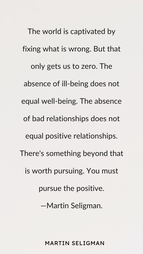
​Whether you struggle with low self-esteem or want to improve your relationships and/or leadership style, knowing your character strengths and becoming familiar with strength-based tools will be the greatest tools you can add to your life tool box. 
Here are some ways to find your strengths and live life with purpose!
Picture
​What is Strengths-Based Psychology?
Strengths-based psychology is an approach to psychology that sees people as more than just a set of problems to be fixed. Rather, it focuses on what can be done to help people become their best selves, both in terms of relating to others and being productive.
A great assessment you can take to learn more about your character strenghts is the VIA Character Strengths Survey. There, you will get to know what your top 5 Character Strengths are. 

​Next, explore how these strengths might manifest themselves in your life. What would happen if you put more effort into using your natural talents? Would it have any effect on the people around you? 
Use daily gratitude practice to also reflect on your day in terms of what character strengths you have used. Maybe you had to negiotiate something or compromise. In this sitiuation you might have shown empathy, social intelligence and communication skills. Or maybe you cooked dinner for friends or family, in which case you could have used your kindness, generosity and creativity. See, it's that easy.
How strengths-based approaches can combat negativity bias
I have a theory. What we focus on the most influences our neural pathways. The more we work in a certain way, the harder it is to deviate away from that. Therapists and coaches with an attitude as the one above are not only making it harder to let go of the negative, but can unintentionally prevent their clients from moving into a place of flourishing. It is a self-feeding negativity loop.
Let's look at what happens when you add an awareness of character strengths into your everyday life: 
You learn to identify your wins easier. Your brain has plasticity, you are training your brain to identify not only your own, but other people's strengths. By doing that you are enhancing the strength of gratitude and appreciation. As a result your relationships become more positive, deeper and more meaningful. You experience what we call “Positivity Resonance”, a positive bonding experience. As a result your self-esteem grows. It's an endless upward spiral into florishing. And yet, so many practitioners refuse to incorporate this into their work. 
You might be saying:"But I don't want to run around with rose-tinted glasses!" Don't worry, your brain has an inbuilt negativity bias to protect your from harm. All that positive approaches do is to shift your perception and vision into “reality”. You see the whole spectrum, not just the negative. It's like getting a new pair of glasses but for your life.
​Why people get stuck in therapy
Let me share an experience I had a few weeks ago during a training weekend for a course I am currently taking: 
One of the tasks we have been given is to do a 20-minute presentation on a topic we feel passionate about. We are asked to suggest topics and then the whole group would vote on what presentations to take further. A majority of the topics were on, yes, you guessed it, problems and difficulties. I suggested positive psychology. There was zero reaction and zero interest from fellow psychotherapists. To me, this is a disappointment, but no surprise. Therapists can also get stuck in a negativity bias loop.
In humanistic therapies Positive Psychology can often be perceived as a fad and “not deep enough”. The vast amounts of scientific evidence are being discounted. 
The majority of my clients are people who have been stuck in therapy but want to give it one more final try. They often report that their therapist kept looking backwards instead of towards a better future. They have gained more awareness in therapy but still don't know how to move forward. When they mentioned that they don't want to look into the past anymore, the therapist would see that as a defence and make that the focus of the session. It's time to work differently. Fixing a problem is not automatically creating something good.
Strengths-based leadership today
I don't usually bring politics into my emails, but here we have a perfect example of great leadership. One of the most inspiring leaders of today is Volodymyr Zelenskyy. His resolve, defiance and resilience is not just inspiring and moving the Ukrainian people, but it is also touching the entire world. How does he do that? 
Yes, we feel empathy seeing the pictures of destruction. People fleeing and seeking refuge. But there is another aspect that touches us: People are being seen and heard. Zelenskyy keeps reminding not only his people but other world leaders and their citizens of their humanity, their character and their strengths. He talks of loyalty, humanity, faith, trust, bravery, perseverance, love, kindness, fairness, leadership, gratitude, hope and even brings in humor in the darkest of times. He sees and appreciates the support he gets and  asks for what he and his people need whilst at the same time not being afraid to also critize without hate. This is why we identify. And this is why we are so moved to show support, civilians take up arms and build defenses, people take refugees into their homes. 
If a country's leader can do all that, imagine what you can do.
​A litte exercise for you to do with a friend
Get together with a friend or your partner and each share for one minute a story of when you were at your best. Try to listen to what strengths the other has exhibited and note them down. After each of you has shared their story, read to eachother the strengths you have identified and evidence them by pointing to the story. Reflect on how this made you feel. Did you feel seen? Did you feel appreciated? Did it feel good to focus on the positives of your friend or partner?

0 Comments

"Do not celebrate your success"?!

8/12/2021

0 Comments

 
Picture

"Do not celebrate your success"

This is not a statement I am making, but it is a “correct” answer in an exam for a meditation course that I participated in. It is run by a yoga school. I call these kind of statements  spiritual gaslighting.
​
Let me tell you why celebrating your success is so important…

In my 13 years of working in mental health and coaching I have seen many people embarrassed of talking about their wins and successes. When I ask about their strengths they would often blush, their body language would change inward. You could feel the discomfort in the room.
 
Most of the time it was a fear of seeming big-headed or appearing as arrogant. I am not talking here about false humility, but of shame.
When this happens I tend to ask about times that were tough, how they overcame them as well as their achievements. Whilst my clients share their stories I look out for signs of strengths they will have used to overcome adversity and note them down on a small whiteboard in front of me, away from my clients' sight. At the end I turn around the whiteboard and show my clients what I have identified. Maybe you can imagine the shock on many faces. When I explain each strength I have spotted, I give an example from what they have told me that proves that this is not some “let's make you feel better” exercise, but instead an honest positive representation of themselves. Those are some of the most beautiful moments in our sessions.  Seeing someone else realize their worth right in front of you and transforming their self-esteem is priceless.
​
So why is it so difficult to celebrate?
 
Many of us tend to focus so much on the daily hustle and bustle and struggle to keep our heads down that we forget to celebrate the successes that we and others have achieved at work and in our private lives. Coupled with pseudo-spiritual statements as the above we are more likely to neglect celebrations. Many of us have never been taught to spot good character traits and strengths in ourelves or others. The effect: you start seeing your achievements negatively. If you focus on what you have not achieved and not on what you are doing, you are less likely to stick to the task and achieve your goals. By not noticing or downplaying your success, you tell yourself that you are doing nothing to be proud of and that you do not deserve to be celebrated. When we celebrate success, no matter how small a win is, we cultivate your success mentality. By telling yourself that success means success, you also succeed at building up your self-confidence and attitude to success.
 
There is a reason why it feels so good when we celebrate success, and it has to do with the neuro-happy chemicals in our brains. Dopamine is released into our brain when we expect to achieve something, and when we achieve it, it feels good, and we want more of it. This way you can condition yourself to seek out that experience again, potentially gaining momentum in productivity and growth.  Taking time to celebrate, not just your own successes, but also the ones of others can elevate your levels of oxytocin and endorphins, increase serotonin and lower cortisol which is responsible for stress. You also experience more moments of positivity resonance with the people around you. These are moments of positive connection that strengthens your bond.
 
How to celebrate if you are not used to it or if you feel shame about it?
Don’t wait for big wins that we have been conditioned to see as the only worthy ones of celebrating. Start celebrating small wins. Those small wins have a ripple effect.
 
Here are six ways you can start celebrating today:
  1. You can start off celebrating just by yourself, with a cup of tea or coffee and just taking a little break and get yourself into the present moment.
  2. How about a victory dance in the kitchen.
  3. Relax and contemplate your win and how you got there. Reflect on your journey and try to identify the strengths you have shown to get you to your win. (Most people never think about their strengths unless they are preparing for a job interview).
  4. You can share with a friend who you are close to and who you trust.
  5. Say thank you to whoever has supported you in your journey.
  6. Have gratitude journal or gratitude jar (yes, gratitude is another way of celebrating your success).
 
Once you are used to celebrating feel free to be more open about your wins and successes. Yes, you might experience envy here and there, but most people around you will join you in your celebration. You might even inspire others to aim for the same goals or to celebrate their own individual wins and successes.
 
Remember, whatever we do has a ripple effect. Just as much as teaching people that celebrating is not healthy can shut people down, sharing your joy and celebrating can teach people to experience healthy pride, increase their sense of self-confidence and bring people closer to each other. All starting off with one little celebration.

0 Comments

    Archives

    November 2024
    October 2024
    September 2024
    August 2024
    May 2024
    February 2023
    April 2022
    March 2022
    January 2022
    November 2021
    August 2021

    Categories

    All
    Adaptability
    Boundaries
    Celebration
    Change
    Character Strengths
    Gratitute
    Happiness
    Healthy Relationships
    Mental Health
    Nervous System
    Positive Psychology
    Psychotherapy
    Self Respect
    Self-respect
    Skills
    Spiritual Gaslighting
    Strengths
    Stress
    Success
    Thrive
    Wins
    Work
    Work Life Balance
    Work Stress

    RSS Feed

Picture

Member of:
UKATA -
UK Association of Transactional Analysis

Picture
Picture
Picture
Picture

​© COPYRIGHT 2023. - Martha Curtis
Statement of Ethical Practice
I conduct myself personally and professionally according to the highest standards of honesty and integrity and always hold the best interests of my clients as paramount and in strict confidence. I continuously strive for excellence in our coaching relationship and do not more outside the limits of my knowledge and expertise. I am a member of the International Coach Federation and abide by their Code of Ethics.
  • Home
  • About
  • Psychotherapy
  • Why Positive Psychology?
  • Coaching
    • For Women
    • Meditation
    • Self-Worth Program
    • For Creatives
    • Positive Psychology Resources
    • For Coaches >
      • Join the Reciprocal Coaching Circle
  • Book a Session here
  • Testimonials
  • How healthy is your social circle? (free worksheet)
  • Articles
  • Let's end 2025 Positively!
  • Get in touch
    • About You
  • Recovery from Narcissistic Relationships Program